

Hey there! As a supplier of Choke Control Panels, I often get asked about the control range of these panels. So, I thought I'd write this blog to give you a detailed breakdown of what the control range of a Choke Control Panel is all about.
First off, let's understand what a Choke Control Panel is. A Choke Control Panel is a crucial piece of equipment in the oil and gas industry. It's used to control the flow rate of fluids, mainly oil and gas, by adjusting the choke valve. The choke valve is like a gatekeeper, regulating the amount of fluid that can pass through a pipeline.
Now, onto the control range. The control range of a Choke Control Panel refers to the spectrum of settings and operations that the panel can handle. It's determined by several factors, including the type of choke valve it's controlling, the design of the panel itself, and the specific requirements of the application.
Types of Choke Valves and Their Impact on Control Range
There are different types of choke valves, and each has its own characteristics that affect the control range of the Choke Control Panel.
Fixed Choke Valves
Fixed choke valves have a set orifice size, which means they can't be adjusted. The control range here is pretty limited. The Choke Control Panel can only control the on - off function of the valve. It's like having a light switch that can only turn the light on or off, not dim it. These are often used in applications where a constant flow rate is required, and there's no need for frequent adjustments.
Adjustable Choke Valves
Adjustable choke valves, on the other hand, offer a wider control range. The Choke Control Panel can adjust the opening of the valve, allowing for precise control of the flow rate. This is like being able to dim a light to different levels. There are two main types of adjustable choke valves: manual and automatic.
Manual adjustable choke valves require an operator to physically turn a handle or wheel to adjust the valve opening. The Choke Control Panel in this case provides a visual indication of the valve position and may also have safety features to prevent over - adjustment.
Automatic adjustable choke valves are controlled by the Choke Control Panel itself. The panel uses sensors to measure parameters like pressure, flow rate, and temperature, and then adjusts the valve opening accordingly. This type of valve offers a very wide control range, as it can respond in real - time to changes in the operating conditions.
Design Factors Affecting Control Range
The design of the Choke Control Panel also plays a big role in determining its control range.
Control System
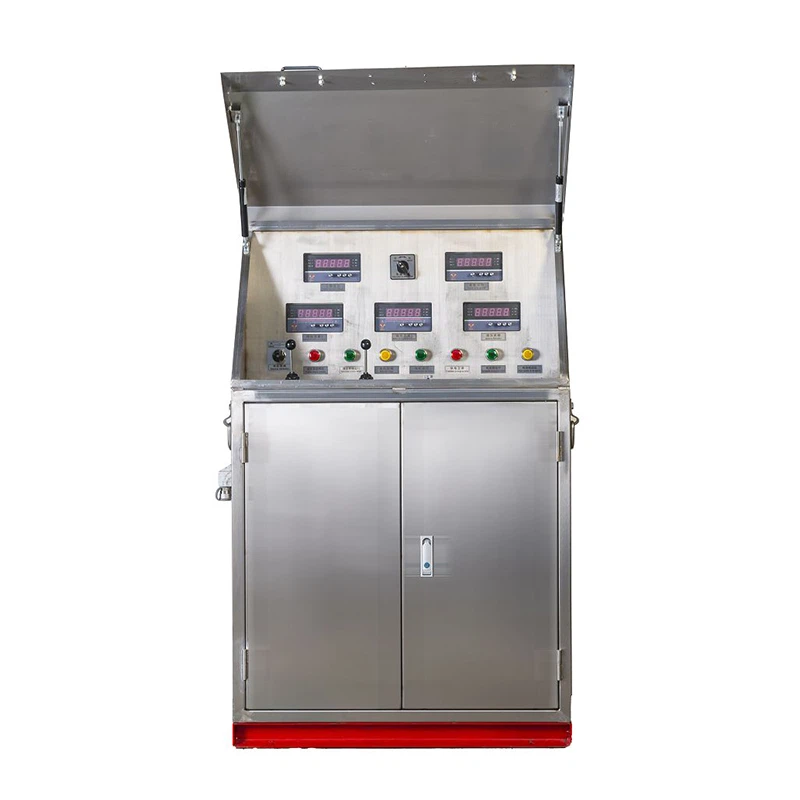
The control system of the panel is the brain behind its operations. A more advanced control system can handle a wider range of input signals and perform more complex calculations. For example, a modern Electric Choke Manifold Control Panel uses digital control technology, which allows for precise and rapid adjustments. It can handle multiple input signals simultaneously, such as pressure from different points in the pipeline, and adjust the choke valve accordingly.
Display and Interface
The display and interface of the Choke Control Panel are important for the operator to interact with the system. A well - designed display can show a wide range of information, including valve position, flow rate, pressure, and temperature. The interface should be user - friendly, allowing the operator to easily adjust the settings within the control range. For example, a touch - screen interface can provide a more intuitive way to control the panel compared to a traditional button - based interface.
Safety Features
Safety features are an integral part of the Choke Control Panel design. They limit the control range in a way that ensures safe operation. For example, there may be limits on how far the valve can be opened or closed to prevent over - pressure or under - flow situations. These safety limits are set based on industry standards and the specific requirements of the application.
Application - Specific Requirements
The control range of a Choke Control Panel also depends on the specific application in which it's used.
Onshore vs. Offshore Applications
Onshore applications may have different requirements compared to offshore applications. Offshore platforms often face more challenging environmental conditions, such as high winds, saltwater corrosion, and limited space. The Choke Control Panel for offshore applications needs to be more robust and have a control range that can handle these harsh conditions. For example, it may need to be able to adjust the flow rate more quickly in response to sudden changes in pressure due to wave action.
Different Stages of Oil and Gas Production
During the different stages of oil and gas production, the control range requirements also vary. In the exploration phase, the flow rate may be relatively low, and the control range may be focused on precise measurement and small adjustments. In the production phase, when the flow rate is higher, the control range needs to be wider to handle larger volume changes.
API Standards and Control Range
The American Petroleum Institute (API) has set standards for choke manifold control panels, such as the API 16C Choke Manifold Control Panel. These standards define the minimum requirements for the control range and other performance parameters. For example, API 16C specifies the accuracy of flow rate control, the range of pressure that the panel can handle, and the response time of the control system. Adhering to these standards ensures that the Choke Control Panel is safe and reliable in oil and gas operations.
Why the Control Range Matters
Understanding the control range of a Choke Control Panel is crucial for several reasons. Firstly, it ensures efficient operation of the oil and gas production process. By being able to precisely control the flow rate, operators can optimize the production output and reduce waste. Secondly, it enhances safety. A well - defined control range with proper safety limits helps prevent accidents such as pipeline ruptures or equipment failures. Finally, it can save costs. By using a Choke Control Panel with the right control range, operators can avoid over - investing in equipment that has a wider control range than necessary.
Contact Us for Your Choke Control Panel Needs
If you're in the market for a Choke Control Panel, we're here to help. Our panels are designed to offer a wide and precise control range, meeting the diverse needs of the oil and gas industry. Whether you need a panel for onshore or offshore applications, or for a specific stage of production, we have the expertise to provide you with the right solution.

Don't hesitate to reach out to us to discuss your requirements and start the procurement process. We're looking forward to working with you to ensure the smooth and efficient operation of your oil and gas production.
References
- API 16C Standard for Choke Manifold Control Panels
- Industry reports on oil and gas production equipment
- Technical manuals of Choke Control Panels